
Mat Pilates vs Reformer Pilates: WHY Mat Pilates Is Having a Moment
For the last few years, Pilates has become almost synonymous with one thing: the reformer.
Beautiful studios. Rows of sleek machines. Matching workout sets. Instagram-worthy classes. Reformer Pilates has undoubtedly had a moment - and it’s introduced a whole new generation to Pilates.
But there’s another side to the Pilates story that is quietly having a resurgence of its own.
Mat Pilates.
I think mat Pilates is having a moment too. And actually, there are some very good reasons why.
What’s the difference between mat PILATES and reformer Pilates?
At its simplest, the difference is the equipment.
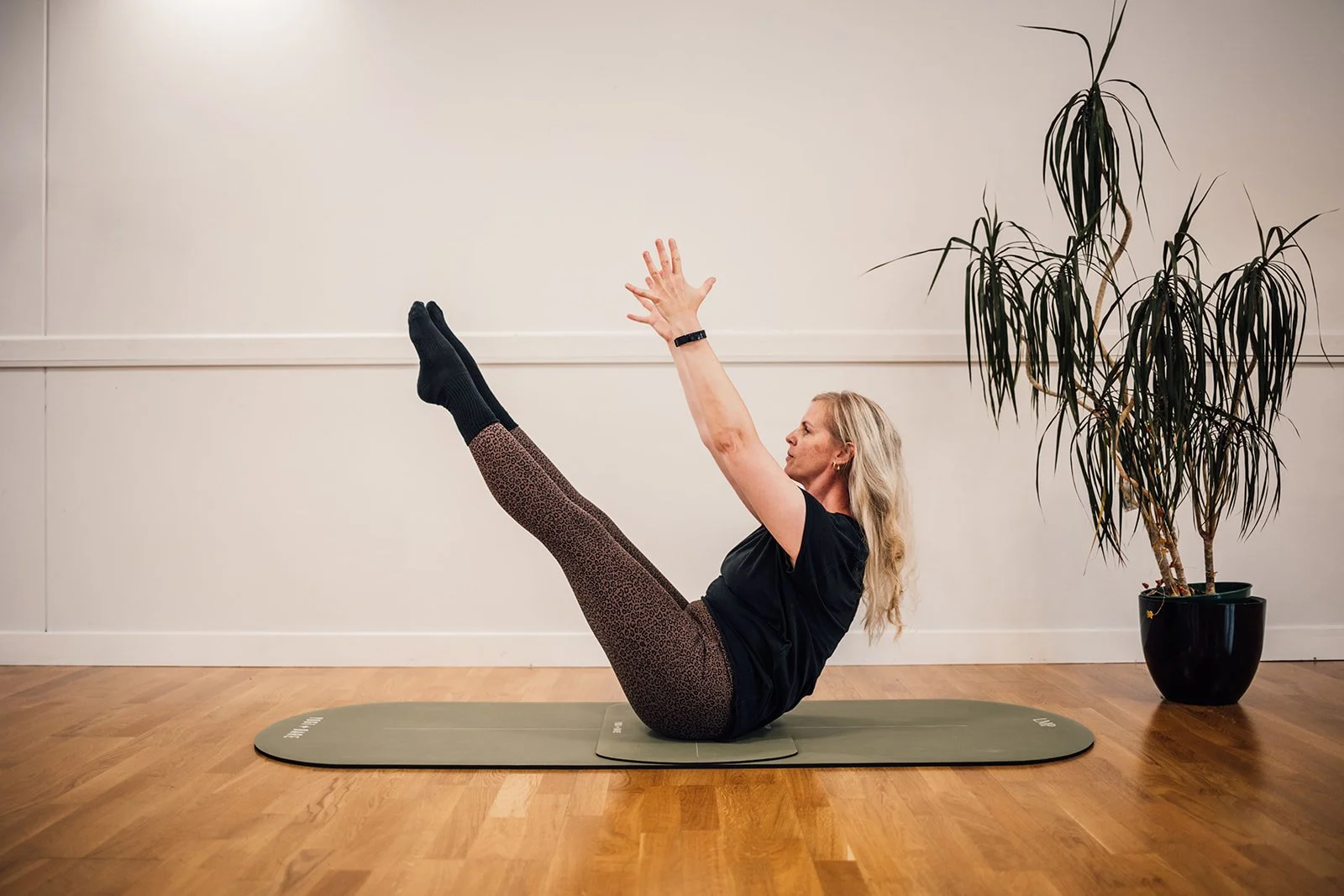
Mat Pilates uses your own bodyweight as resistance, usually on a mat, sometimes with small pieces of equipment such as resistance bands, Pilates balls, magic circles or hand weights.
Reformer Pilates uses a specialised piece of equipment with springs, a moving carriage, straps and a variety of attachments to provide resistance and assistance.
Both can be challenging. Both can improve strength, mobility, balance and body awareness. And both are rooted in the original Pilates method developed by Joseph Pilates.
But they offer quite different experiences.
And right now, I think there are several reasons why people are rediscovering the benefits of keeping things simple.
1. You don't actually need a machine to do Pilates
One of the most appealing things about mat Pilates is also one of the simplest: you can do it almost anywhere.
You don't need a reformer. You don't need a specialist studio. You don't need an expensive membership.
All you really need is enough space to lie down and a mat.
That makes mat Pilates incredibly accessible and affordable - whether you're joining a weekly class, practising at home or taking your Pilates with you when you travel.
And while a reformer can provide useful resistance and support, your body can provide plenty of challenge on its own.
In fact, a lot of the mat exercises can be surprisingly difficult!
2. Mat Pilates makes you work with your own body
There's something very honest about mat Pilates.
There is no machine moving underneath you and no springs providing resistance. An expression I often use about mat Pilates is “there is nowhere to hide” You have to learn how to control your own body without the support from the reformer.
That means developing awareness of things such as your posture, breathing, alignment, stability and movement quality.
You might slow an exercise down. You might hold a position for longer - increasing the time under tension. You might add a small piece of equipment to increase the challenge.
The result is a workout that can look deceptively simple from the outside - but feel very different when you're actually doing it.
3. It's incredibly adaptable
One of the things I love most about mat Pilates is that the same class can work for a room full of completely different bodies.
A good Pilates teacher can offer different options for an exercise depending on someone's experience, strength, mobility or how they're feeling that day.
You don't necessarily need to be able to perform the "perfect" version of an exercise to benefit from it.
You can make an exercise smaller.
You can reduce the range of movement.
You can use a prop.
You can change your position.
Or you can take the more challenging option if you're ready for it.
That's particularly important as we get older, because our bodies aren't necessarily the same from one day to the next — and that's perfectly normal.
4. mat pilates can be challenging without being punishing
There's a growing appetite for exercise that makes us feel better, rather than simply exhausted.
Mat Pilates fits beautifully into that space.
It can build strength and challenge your muscles without necessarily leaving you feeling like you've been hit by a bus afterwards.
And because so much emphasis is placed on controlled movement, breathing and body awareness, Pilates can feel very different from a traditional high-intensity workout.
You can work hard without feeling that you have to destroy yourself to make the workout worthwhile.
5. Small equipment can make mat Pilates surprisingly interesting
"Mat Pilates" doesn't necessarily mean lying on a mat doing the same sequence every week.
Far from it.
Small equipment can completely change an exercise.
Resistance bands can add tension. Pilates balls can challenge stability. Magic circles can increase resistance. Weights can introduce an extra strength element.
And because the equipment is small and relatively inexpensive, it doesn't require a dedicated studio full of machines.
This gives a Pilates teacher enormous scope to keep classes varied and progressive, whilst still staying true to the original Pilates principles. You can read more about the Pilates principles here.
6. mat pilates is more accessible and affordable
This isn't necessarily true in every case, but generally speaking, mat Pilates classes can be considerably more affordable than specialist reformer classes.
Reformer studios have significant overheads. The equipment itself is expensive, studios often have limited numbers of reformers, and classes tend to be smaller.
That can make reformer Pilates a more expensive form of exercise.
Mat Pilates doesn't have quite the same equipment requirements, which means you can often access a regular class for less.
And if you're looking for something you can sustain over the long term, affordability matters.
There's little point finding an exercise you love if you can't realistically fit the cost into your life.
7. You can take mat pilates with you
There's something particularly appealing about an exercise that doesn't depend on a particular location.
Going away for the weekend? Take your mat.
Staying in a hotel for work? You probably have enough floor space.
Can't get to your usual class? You can still practise at home.
That flexibility makes mat Pilates a much easier habit to maintain.
And consistency is far more important than having the most impressive piece of equipment.
8. Mat Pilates brings us back to the fundamentals
Perhaps the biggest reason I think mat Pilates is having a moment is that we're beginning to look beyond the equipment and remember what Pilates actually is.
Pilates wasn't invented as a machine-based boutique fitness trend. Joseph Pilates developed a system of exercises designed around control, concentration, precision, breathing and flowing movement.
The reformer is an incredibly clever piece of equipment, and it has an important place within Pilates. Joseph originally designed the reformer as a temporary bridge to allow clients who weren’t able to perform the exercises on the mat. The reformer helped them to feel the exercise in their body, and to build the strength that would then allow them to transfer this to the mat.
But the equipment isn't what makes something Pilates. The method is. And you can experience that method beautifully on a mat.
So… is mat Pilates better than reformer Pilates?
I don't think it needs to be an either/or decision.
Reformer Pilates can be fantastic. The springs can provide resistance, assistance and feedback that you simply can't replicate in exactly the same way on a mat.
But mat Pilates has some pretty compelling advantages too.
why mat pilates might be right for you
It's accessible. It's adaptable. It's portable. It's affordable. And it teaches you to move your own body with control.
Maybe mat Pilates isn't having a comeback after all…
Maybe it never actually went anywhere.
While reformer Pilates has taken the spotlight, mat Pilates has been quietly doing what it has always done: helping people move better, get stronger and feel more at home in their bodies.
And perhaps that's exactly why it's having a moment again.
